To answer the question "what is a payday loan?" in plain financial terms: a payday loan is a short-duration, unsecured consumer cash advance—typically ranging from $100 to $1,000—designed to bridge an urgent expense until the borrower's next paycheck arrives. Depending on state statutes, these transactions are legally classified as deferred presentment services, deferred deposit loans, or short-term payroll advances.
Core Structural Features of a Payday Advance
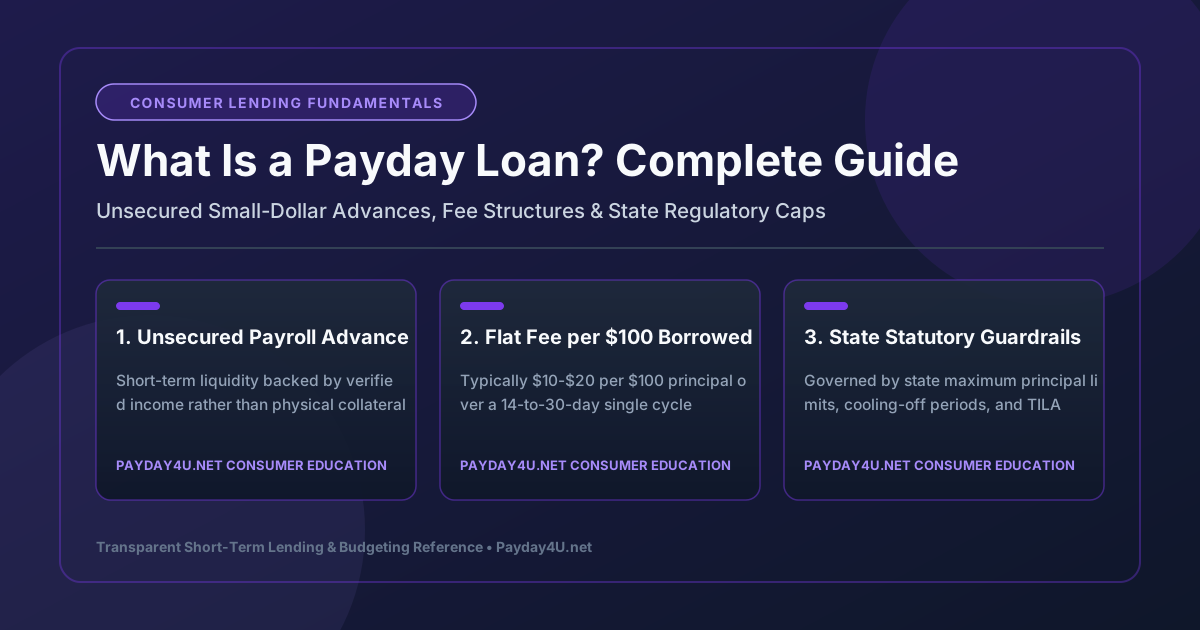
Unlike an auto title loan (which requires pledging your vehicle's certificate of title as physical collateral) or a multi-year bank installment loan (which amortizes across 24 to 60 monthly payments), a traditional payday loan has three defining characteristics:
- Unsecured by Physical Collateral: You do not pledge a car, home, or personal property. Instead, the loan is backed by your verified incoming paycheck and an electronic Automated Clearing House (ACH) debit authorization or post-dated personal check.
- Single-Balloon Maturity Aligned With Payday: The entire principal plus the finance fee matures in a single lump sum on your next scheduled pay date, typically 14 to 30 calendar days after origination.
- Flat Dollar Pricing per $100 Borrowed: Rather than charging compounding monthly interest, licensed lenders quote a flat dollar fee—most commonly $10 to $20 per $100 advanced.
Why Do Payday Loans Show a High Annual Percentage Rate (APR)?
Under the federal Truth in Lending Act (TILA), all lenders must convert their flat finance charge into an annualized percentage rate (APR) so consumers can compare credit costs across a 365-day year. Because a payday advance only lasts 14 days, multiplying a two-week fee across 26 two-week periods produces a triple-digit annualized figure:
| Credit Product ($300 Borrowed) | Typical Term Length | Actual Dollar Fee Paid | Annualized APR Figure |
|---|---|---|---|
| Payday Advance ($15 per $100 fee) | 14 Calendar Days | $45.00 flat finance charge | 391.07% APR (26.07 two-week cycles/yr) |
| Payday Advance ($15 per $100 fee) | 30 Calendar Days | $45.00 flat finance charge | 182.50% APR (12.17 monthly cycles/yr) |
| Credit Union PAL II Installment Loan | 6 Monthly Installments | ~$24.80 total interest | 28.00% maximum statutory APR |
| Bank Checking Overdraft ($35 Fee) | 7 Days Until Next Payday | $35.00 overdraft penalty | 608.33% equivalent annualized rate |
How State Laws Regulate Small-Dollar Lending
Because federal law (Dodd-Frank Act § 1027(o)) leaves interest rate ceilings to individual states, payday lending rules vary significantly by jurisdiction. Some states permit regulated single-payment advances with statutory fee caps (such as $15 per $100) and mandatory cooling-off periods between loans; other states require amortizing multi-month installment structures; and several states enforce a strict 36% APR usury cap across all consumer loans. Always review your state's banking regulator guidelines before borrowing.