Learning how a payday loan works step by step demystifies short-term credit and empowers you to verify every fee, date, and regulatory safeguard before borrowing. Whether originated online or at a state-licensed retail center, a payday loan is a single-cycle, small-dollar cash advance—typically between $100 and $1,000—where the borrower authorizes the lender to collect the principal plus a flat statutory finance fee on the borrower's very next payday.
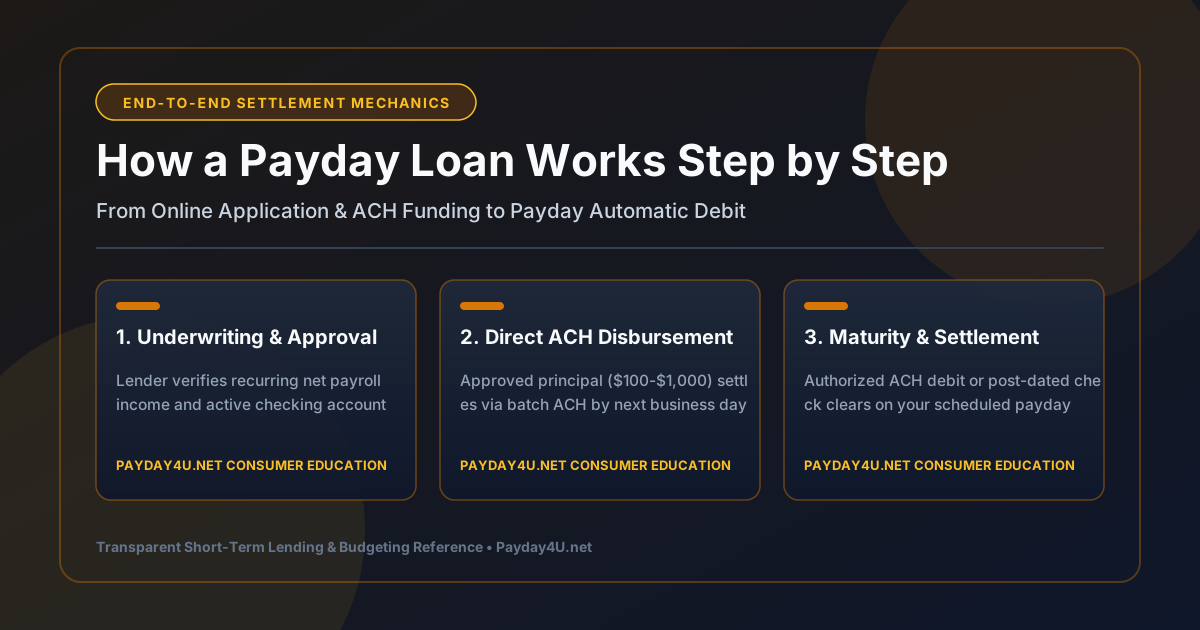
Step-by-Step Breakdown of the Payday Loan Cycle
Step 1: Online Intake & Cash-Flow Underwriting
You begin by submitting your contact details, employment income schedule, and checking account routing and account numbers. Instead of relying on traditional prime credit bureaus, the lender evaluates your recent payroll direct-deposit history and specialty short-term credit bureaus to verify that you have steady incoming wages and an active bank account.
Step 2: Truth in Lending Disclosure & E-Signature
Upon approval, the lender presents a formal loan contract displaying the mandatory Truth in Lending Act (TILA) disclosures: the exact principal advanced, the dollar finance charge (commonly $10 to $20 per $100 borrowed depending on state law), the equivalent Annual Percentage Rate (APR), and the exact calendar maturity date. Once you review and apply your electronic signature, the contract becomes binding.
Step 3: Direct ACH Principal Funding
The lender transmits an Automated Clearing House (ACH) credit instruction to your depository bank. For contracts signed before the lender's daily banking cutoff, funds typically post to your checking account on the next business morning (or the same afternoon where same-day ACH or debit-card push rails are supported).
Step 4: Payday Maturity & Automatic Debit
On your scheduled pay date—typically 14 to 30 days after origination—the lender initiates an ACH debit for the combined principal and finance fee. Once that single payment clears alongside your incoming paycheck deposit, the loan is paid in full.
| Cycle Milestone | Typical Timeline | Borrower Action Required | Key Regulatory Protection |
|---|---|---|---|
| 1. Application & Verification | Day 1 (5–10 minutes) | Submit accurate income and checking details | GLBA data privacy & 256-bit TLS encryption |
| 2. Contract & TILA Review | Day 1 (Immediate) | Inspect flat fee, APR, and maturity date before signing | Truth in Lending Act (12 CFR Part 1026) |
| 3. Principal Disbursement | Day 1 afternoon or Day 2 AM | Confirm deposit arrival in checking ledger | Nacha operating rules for ACH credits |
| 4. Payday Settlement | Day 14 to Day 30 (Payday) | Maintain full balance in checking account on due date | Regulation E & CFPB 2-attempt debit limit |
What Happens If Your Paycheck Is Delayed?
If an employer payroll delay or unexpected medical absence threatens your ability to cover the full ACH debit on maturity day, contact your lender at least 48 hours before the scheduled withdrawal. Many state statutes and industry standards provide a no-cost Extended Payment Plan (EPP) that divides your balance across four pay cycles without adding rollover fees or triggering bank overdraft charges.